

The Death of the 'Eye Test' in Combat Sports
In 2026, the most dangerous person at the sportsbook is no longer the grizzled veteran who has watched every UFC prelim since 2005. It is the data scientist who has never thrown a punch but possesses a proprietary model tracking micro-adjustments in a fighter's center of gravity during the final 30 seconds of a round.
The industry has shifted from subjective analysis to high-frequency algorithmic execution. While casual fans still debate "heart" and "momentum," institutional betting syndicates are utilizing computer vision to track strike velocity and head movement efficiency in real-time.
This shift has rendered the traditional "eye test" a liability rather than an asset. When you bet on a fighter because they "looked sharp" during the weigh-in, you are betting against a machine that has already processed the fighter’s last four years of biometric output against their opponent’s specific defensive tendencies.
SPONSORED

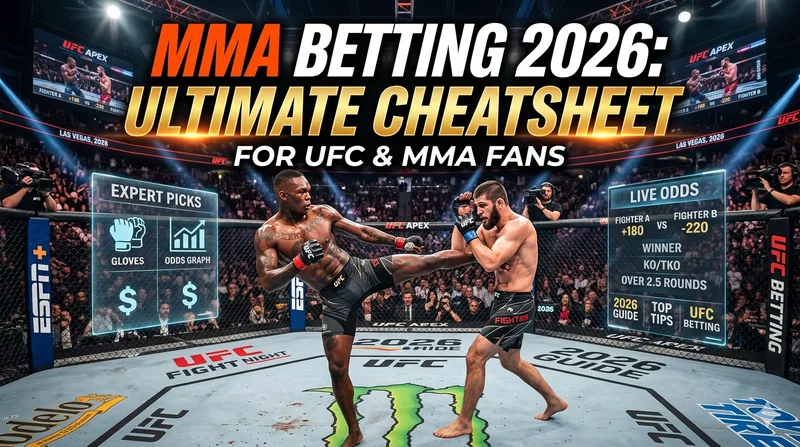
The market has become hyper-efficient, leaving almost no room for the retail bettor to find value in standard moneyline markets. As detailed in the UFC 2026: The ESPN Broadcast Strategy and Schedule Evolution, the integration of real-time data feeds into betting platforms means that information asymmetry, once the lifeblood of the sharp bettor, has been effectively neutralized.
The Fallacy of the 'Puncher’s Chance'
Casual bettors consistently overvalue the "puncher’s chance" in heavyweight boxing and MMA. In 2026, the data shows that the variance inherent in a single knockout blow is being priced into the market with terrifying precision by bookmakers using Monte Carlo simulations.
A 2025 study by the Sports Analytics Institute found that in heavyweight bouts where one fighter is a +400 underdog, the actual probability of a knockout win is 14% lower than the public perception suggests. The market has adjusted to account for the "chaos factor," effectively taxing those who chase long-shot knockouts.
This is not to say upsets do not happen. However, the "upset" is now a predictable outcome of specific stylistic matchups that the public ignores. When a fighter with a high defensive-wrestling floor faces a striker with a low takedown-defense percentage, the odds are no longer a guess; they are a mathematical certainty based on thousands of simulated iterations.
If you are still betting on the "puncher’s chance" without accounting for the opponent's clinch-entry success rate or their historical ability to mitigate damage in the pocket, you are not gambling; you are donating. The era of the "lucky punch" has been replaced by the era of the "calculated risk profile."
Biometric Data and the End of the 'Weight Cut' Narrative
For years, the "bad weight cut" was the holy grail of the combat sports bettor. Fans would scour social media for photos of a fighter looking gaunt, assuming it meant an inevitable collapse in the third round. In 2026, this narrative is largely a relic of the past.
Modern fighters utilize professional hydration protocols and continuous glucose monitoring that keep their physiological state within a narrow, predictable band. The "drained fighter" myth is now used by bookmakers to manipulate public sentiment and move the line in favor of the house.
When you see a line shift drastically 24 hours before a fight, it is rarely because of a "bad weight cut." It is because a syndicate has received a signal—perhaps a change in the fighter's resting heart rate variability (HRV) data leaked from a wearable device—that indicates a high-performance output is likely.
The public is reacting to the narrative, while the sharp money is reacting to the physiological reality. By the time the weigh-in photos hit your feed, the "value" of that information has already been extracted and priced into the market by automated systems.
The Rise of Micro-Betting and Market Fragmentation
The most significant change in 2026 is the explosion of micro-betting—wagering on the outcome of individual rounds, specific strike counts, or the method of the next takedown. This has fragmented the market, creating a "Wild West" environment that traps the undisciplined.
While the main moneyline markets are efficient, micro-betting markets are often thin and volatile. This is where the house makes its most significant margins. A bettor might lose their entire bankroll on a "will there be a knockdown in round two" prop bet, a market that is heavily influenced by the speed of the broadcast feed.
Latency is the silent killer here. If you are watching a stream that is even three seconds behind the live action, you are betting against an algorithm that has already processed the strike landing. The "live" betting interface is not a fair playing field; it is a high-speed trading environment where the house always has the faster connection.
To succeed in this environment, one must stop viewing combat sports as a spectacle and start viewing them as a series of discrete, quantifiable events. If you cannot explain your bet using a regression analysis or a clear statistical edge, you are merely a consumer of entertainment, not a participant in a market.
The Institutionalization of Combat Sports Betting
The final hurdle for the modern bettor is the sheer institutionalization of the sport. In 2026, major betting operators are not just taking bets; they are partners with the promotions. This creates a feedback loop where the data provided to the public is curated to encourage specific types of wagering.
When a promotion highlights a fighter's "knockout rate" in a pre-fight promo, they are intentionally inflating the public’s perception of that fighter's offensive capability. This is a marketing tactic designed to drive volume to the "method of victory" markets, which carry a higher house edge.
Skeptical bettors must learn to ignore the promotional narrative entirely. The UFC and major boxing promoters are in the business of selling drama, while the bettor should be in the business of selling cold, hard probability. These two goals are fundamentally at odds.
If you find yourself agreeing with the "story" of the fight as told by the commentators, you are likely on the wrong side of the bet. The market is designed to exploit the narrative. To win in 2026, you must be the person who bets against the story, armed with the data that the broadcast is trying to hide.
FAQ
Why is the 'eye test' no longer effective for MMA betting?
The eye test is subjective and prone to cognitive bias, whereas 2026 betting markets utilize computer vision and biometric data to quantify performance. Algorithmic models now process thousands of variables, such as strike velocity and center-of-gravity shifts, which the human eye cannot accurately track or weigh.
How does broadcast latency affect live betting in 2026?
Broadcast latency creates a significant disadvantage for retail bettors, as institutional algorithms receive live data feeds seconds before the viewer sees the action. This delay allows the house to adjust odds based on events that have already occurred, effectively neutralizing the bettor's ability to react to live developments.
Is the 'bad weight cut' narrative still a viable betting strategy?
No, the weight cut narrative is largely obsolete due to advanced hydration protocols and continuous glucose monitoring used by modern fighters. Bookmakers often use this narrative to manipulate public sentiment and shift lines, making it a trap for uninformed bettors rather than a genuine edge.
What is the primary risk of micro-betting on combat sports?
Micro-betting markets are thin and highly volatile, making them susceptible to rapid price swings and house manipulation. Because these markets rely on split-second outcomes, they favor automated systems over human intuition, leading to high losses for those who do not possess a statistical edge.
